
How do I read the Loan Portfolio dashboard?
How much loan balance is payroll currently carrying, how much has been recovered, and where it concentrates — across every employee loan scheme payroll deducts and administers.
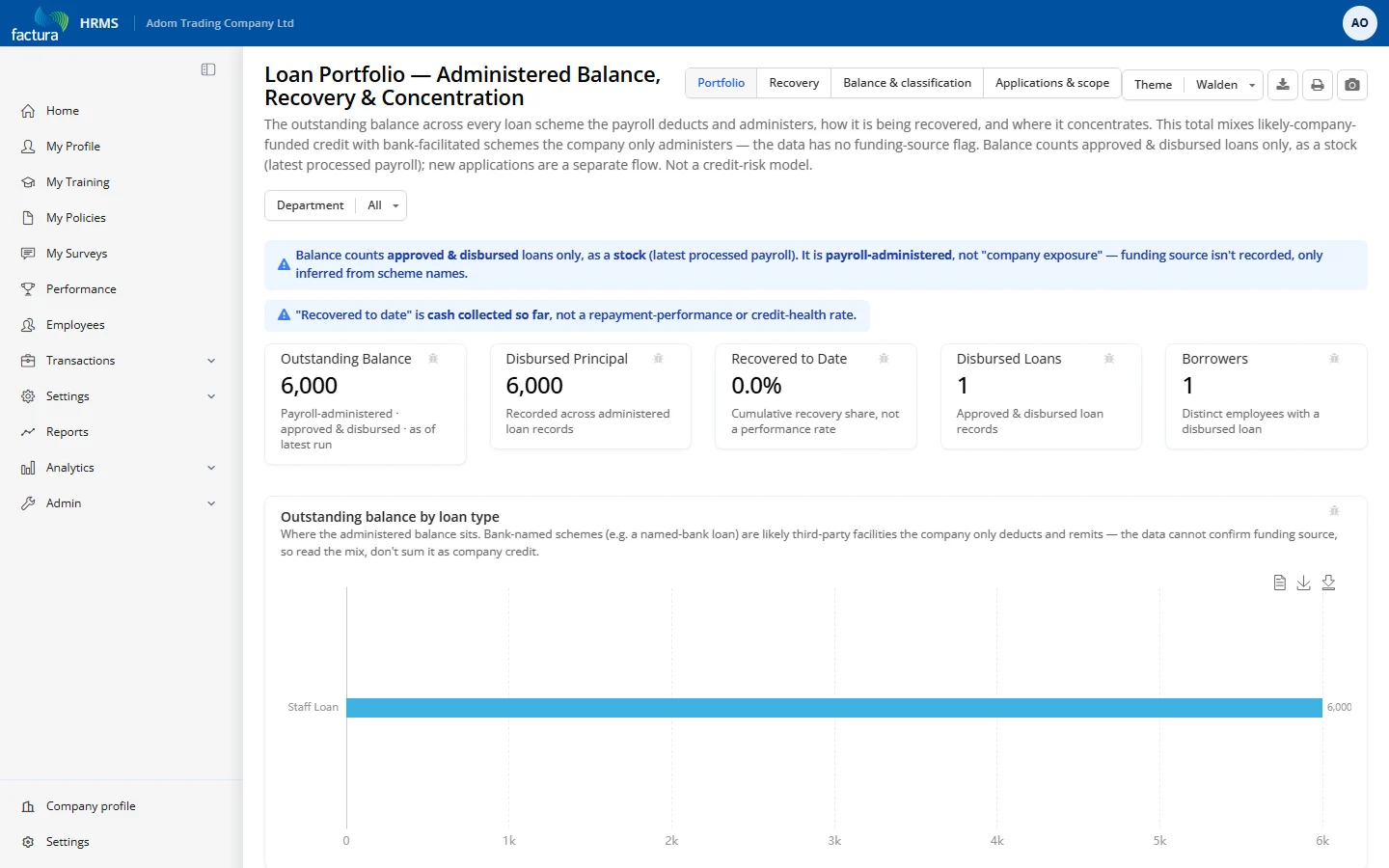
Who it's for: HR/payroll managers, finance.
KPI tiles
- Outstanding Balance — still owed on approved & disbursed loans, as of the latest processed payroll.
- Disbursed Principal — total originally lent across administered records.
- Recovered to Date — cumulative cash collected, as a % of principal (not a performance score).
- Disbursed Loans — count of approved & disbursed records.
- Borrowers — distinct employees currently holding a disbursed loan.
Charts & tables (by tab)
- Portfolio — Outstanding balance by loan type (bar); Loans by type grid (count, principal, outstanding).
- Recovery — Principal recovered to date by loan type (disbursed, recovered, outstanding, recovered %).
- Balance & classification — a funnel from all loan records → draft/submitted → rejected/cancelled → approved → disbursed → outstanding (shows exactly which records count); plus outstanding concentration (top decile + load multiple), shown only with 50+ borrowers.
- Applications & scope — new disbursed loans by application year (a trend); stock-vs-flow reference table.
Filters & controls
- Department multi-select; four tabs; CSV export. No period picker on the balance KPIs — the balance is always "as of the latest processed payroll"; only the origination chart is by year.
How to read it
- KPIs count only approved & disbursed loans — draft/pending/rejected/undisbursed are excluded (see the funnel if numbers look low).
- Outstanding is a stock (snapshot); originations are a flow (per year) — don't apply a date filter to the balance.
- The total mixes company-funded credit with bank-facilitated loans the company only deducts & remits; scheme names only loosely infer the funding source — treat it as a signal.
- "Recovered to Date" is cumulative cash, not a repayment rate — a young scheme shows low recovery simply because little has come due.