
What it takes to make it, costed against the same stock.
Bills of materials, the manufacturing journal, and consumption and production reporting in Factura Financials, using the same items, godowns and valuation the rest of your books run on.
Bill of materials
A bill of materials is held against the stock item it produces, and an item can carry more than one, a named recipe per grade, per pack size, or per plant, with one of them marked as the default.
What it does
- Multiple named bills per item, so a second formulation is a second bill rather than a second item code.
- A base quantity on each bill, so components are stated per batch rather than per unit where that is how the floor works.
- A default bill flagged, so the journal knows which one to explode when nobody chooses.
- An item-kit flag for assemblies that are packed rather than processed.
- Excel import for bills of materials, matched from your header row rather than a fixed template.
Where the boundary is. Factura’s bill of materials does not carry separate co-product or by-product fields. If a process yields two saleable outputs, that is worth walking through with us before you commit, not after.
The manufacturing journal
The journal is where a bill of materials becomes a movement. It explodes the bill, computes the maximum quantity you could produce from the stock actually on hand, and posts the consumption and the output through the same voucher engine every other document uses.
What it does
- Explodes the bill against real stock, so a production plan is checked against the godown rather than against an intention.
- Posts components out and finished goods in as one document, with the valuation moving with them.
- Runs on a voucher type you configure: the process-journal option is a setting on the voucher type, so your numbering and naming stay yours.
- Reaches the ledger the same way as a sales invoice or a journal, which is why production shows up on the statements without a separate posting run.
Finished goods that need checking before they move to stock go through quality control at the production stage.
Consumption and production reporting
What the floor consumed against what the bill said it should, and where each order stands — read off the journals, in the same report gallery as the rest of the accounts.
What it does
- Manufacturing journal comparison and variance: planned against actual consumption, journal by journal.
- Material consumption summary: what has been drawn, by item, over a period.
- Manufacturing order details and order status: where each order stands.
- Manufacturing reorder status: the components that will run you short.
Where the boundary is. There is no standalone bill-of-materials report. The bill is visible on the item and inside the journal that explodes it.
Manufacturing is licensed separately
Manufacturing is not part of every Factura Financials installation. It is switched on by a licence flag, and where that flag is absent the manufacturing menus, the process-journal option on a voucher type and the three manufacturing order reports are hidden rather than shown greyed out.
We put this on the page rather than in a footnote, because it changes what you are buying. Ask for manufacturing at the demo and we will show it running on a real bill of materials, so you see what the licence covers before anyone quotes for it.
Costing, and what “job costing” means here
Job costing in Factura is cost-centre accounting, used for jobs. We would rather say that than let the phrase imply a module that does not exist.
- There is no job-work module.
- No job-work-in or job-work-out voucher types, no job master. What exists is the general cost-centre and project machinery, applied to a job.
- Cost centres nest without a depth limit.
- A cost centre carries a parent, and Factura checks only that you have not made a loop, so a line, a shift and a machine can each be a level.
- Cost centres are switched on per ledger,
- so you allocate on the postings that need it and leave the rest alone.
- Projects are their own master
- : parent, status, start, end and projected-end dates, and a project value to budget against.
- Budgets are hierarchical
- and can be kept project-wise, with periods and per-scope rows against a cost centre, a group, a ledger or a stock item.
- Job-work analysis is a project report,
- not a manufacturing one. It sits with material consumption behind project accounting, which is why it is described here rather than above.
The plant itself is a fixed asset
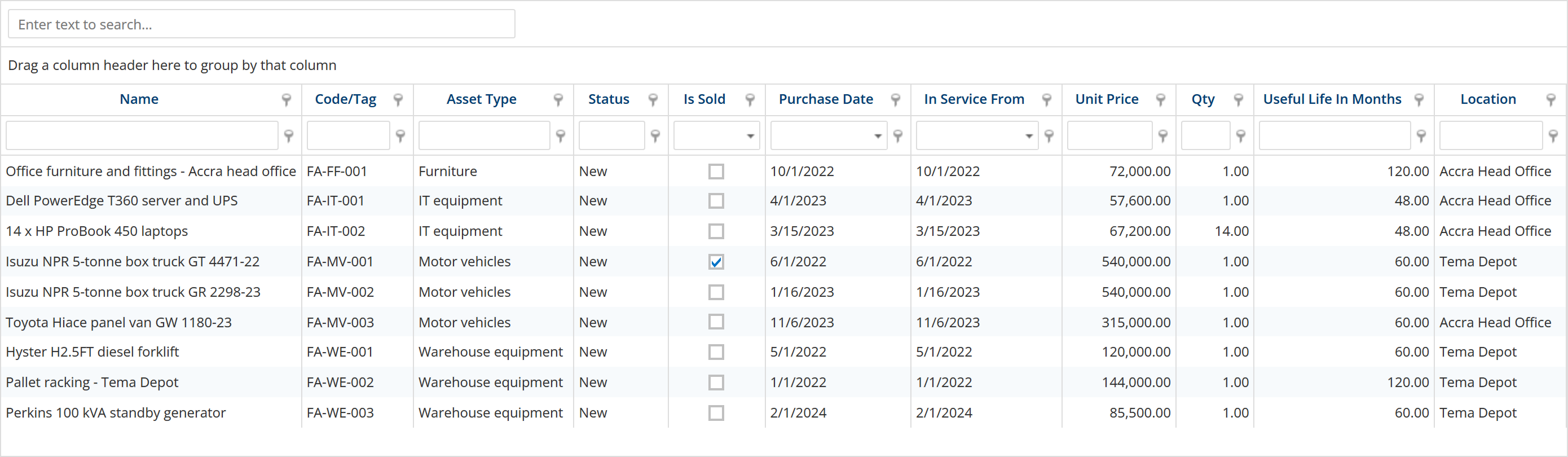
A machine a run consumes materials on does not sit outside the books — it is a fixed asset, with its own cost, useful life and depreciation, in the same register as everything else the business owns.
Before you ask us
Is manufacturing included in Factura Financials?
Not by default. It is enabled by a licence flag; without it the manufacturing menus, the process-journal voucher-type option and the manufacturing order reports do not appear. Ask for it at the demo and we will show it switched on.
Do you do material requirements planning?
Not as a planning run. What you get is the manufacturing journal computing the maximum producible quantity from stock on hand, reorder levels on items, and a manufacturing reorder status report naming what will run you short. If you need a full MRP schedule, we are not it. Better you hear that now.
Can we cost a job across labour, machine and material?
Through cost centres. Allocate the postings you care about to a cost centre. Cost centres nest as deep as you need; then read the cost-centre reports. There is no dedicated job-costing module underneath that, and we would rather you knew before you bought.
Can we load our bills of materials from a spreadsheet?
Yes. Bills of materials have an Excel import alongside stock items, opening stock and price lists. The columns are matched from your header row, so you do not have to reshape the file first.
The rest of the modules
Manufacturing uses the same items, godowns and ledger as everything below.
- Inventory.
- The items a bill of materials consumes and produces, and the godowns they sit in. See Inventory →
- General ledger.
- Where the journal posts, and where cost centres and projects live. See the General Ledger →
- Purchasing.
- How components arrive, with freight and duty in their landed value. See Purchasing →
- Sales and invoicing.
- How the finished goods leave. See Sales & Invoicing →
- Analytics.
- Action, Position and Performance off the same books. See Analytics →
- The plant itself.
- The machine a run consumes materials on is an asset, depreciating on its own method into its own ledgers. See Fixed Assets →
- All of it together.
- Back to Factura Financials →
See a month close, end to end
Thirty minutes. Post, reconcile, report — and you can stop us anywhere.