
Controlled buying, with the approval before the commitment.
Requisitions, purchase orders, receipt notes, supplier invoices and payments in Factura Financials, each one a document, each one landing on the payables you have to fund.
Requisitions and purchase orders
Buying starts before the order. A reorder level raises the need, a requisition carries it, and the order is the point at which money is committed — which is why the approval sits there.
What it does
- Reorder levels per item, so a requisition is raised against a figure rather than a memory.
- Purchase orders that carry supplier, items, prices and terms into the receipt note and the invoice without retyping.
- Multi-step approvals: a real sequential approver chain, with a pending list per approver, a completed list, and the next approver notified by email.
- Order books and pending-bill reports for purchases, from the same report form the sales side uses, filtered by voucher type.
- Part-receipt and pre-closure: what is still outstanding on an order is its ordered quantity less what has been billed and what has been cancelled.
Material requests
A request raises the need before anything is ordered, for a purchase, a transfer between godowns, a material issue, or something to manufacture. It is one document for all four.
What it does
- One request, four purposes: purchase, godown transfer, material issue or manufacture, with a cost centre carried on the request itself.
- Lines carry item, godown, quantity, required-by date and remarks, so the request is specific from the start.
- Approval through a configured approver chain: the same sequential engine purchase orders use; without a chain set up, a request approves itself.
- An approved request creates the document that fulfils it — a purchase order, or the stock journal or manufacturing journal — linked back to the request both ways. Where purchase orders are numbered by hand, you are asked for the number.
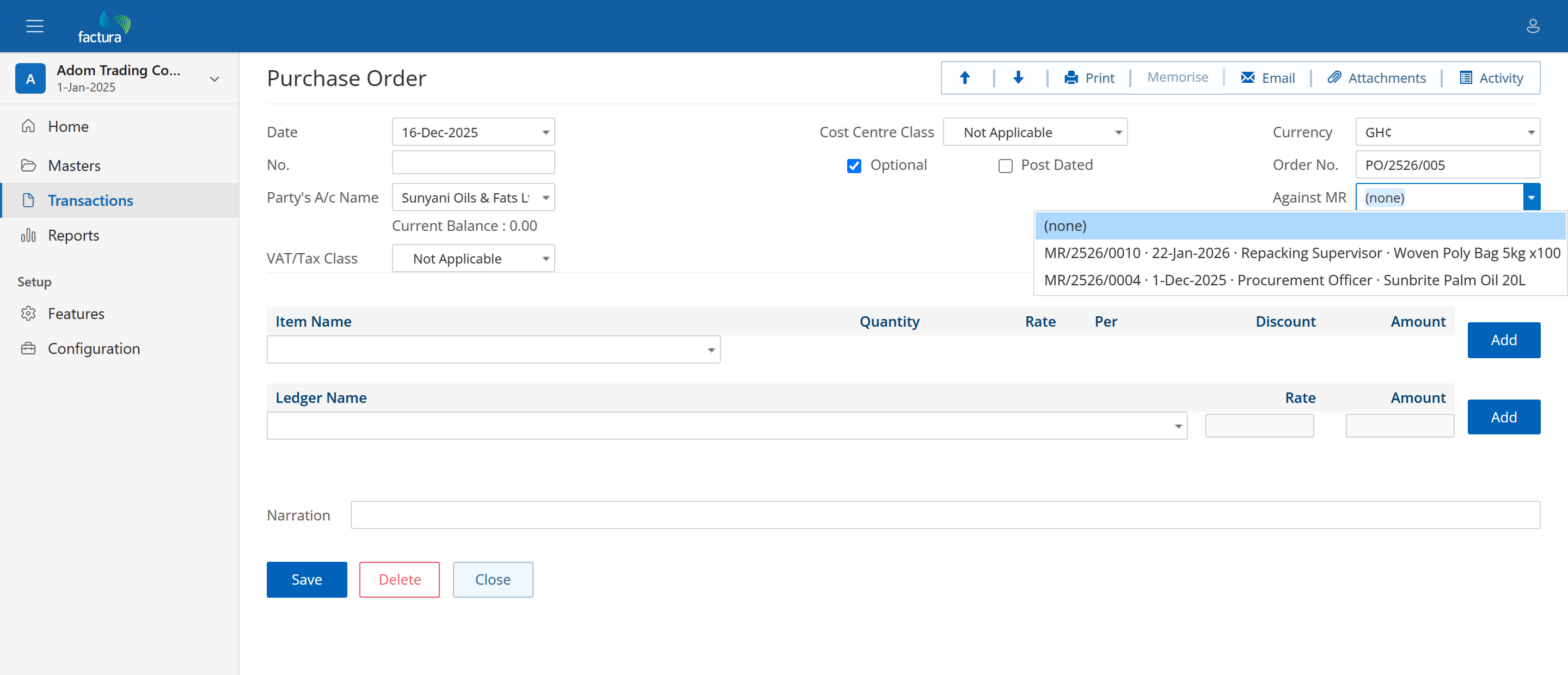
- Or start from the voucher. A new purchase order, stock journal or manufacturing journal can pick the approved request it is raised against, and once saved it carries a banner naming the request it fulfils. An order raised separately can be linked to a request afterwards, and any link can be undone.
- A line-by-line trace of what has been ordered, received and fulfilled. A purchase request moves from Pending through Ordered to Received, counting receipts net of returns; a transfer or issue ends at Fulfilled.
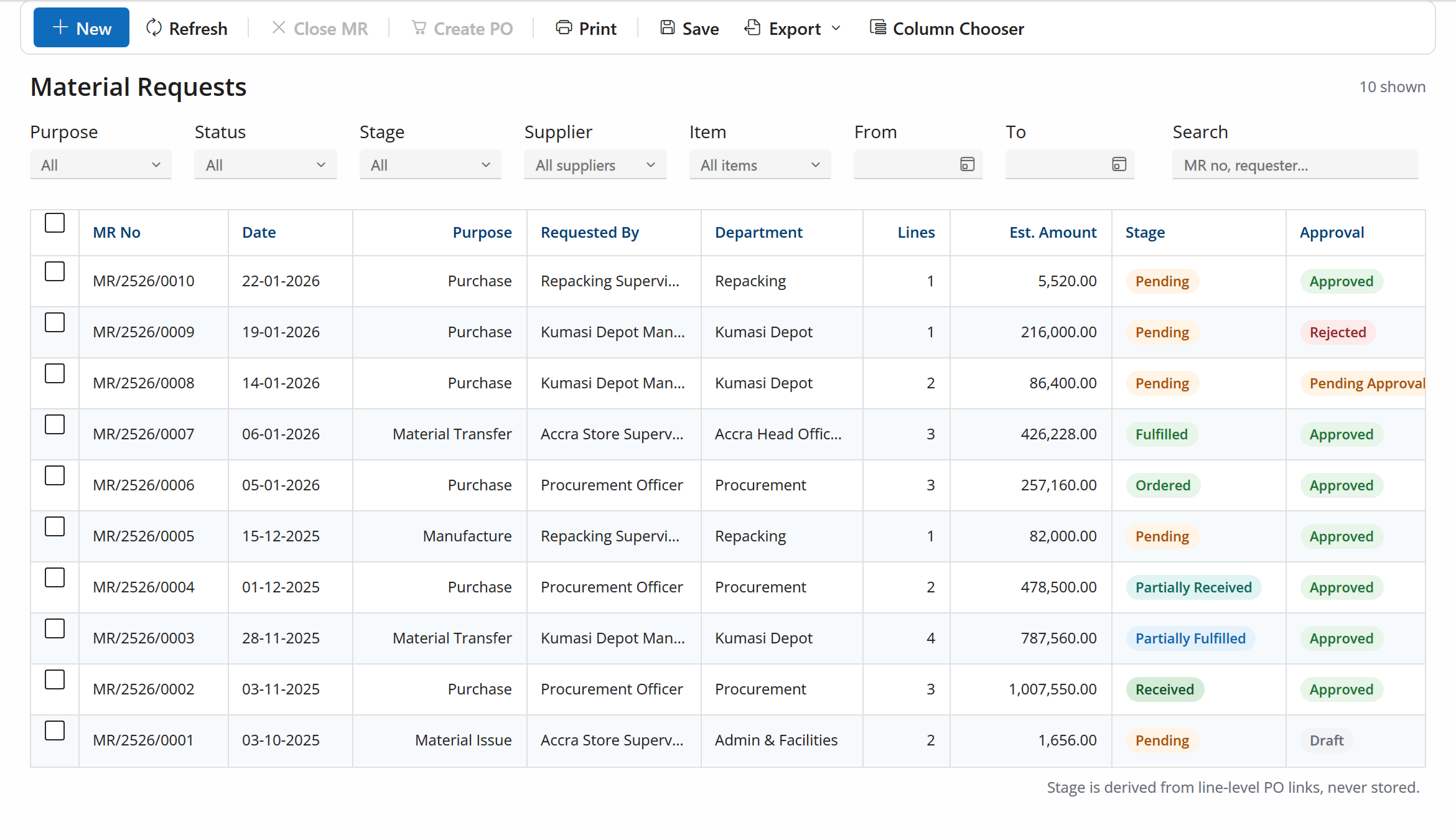
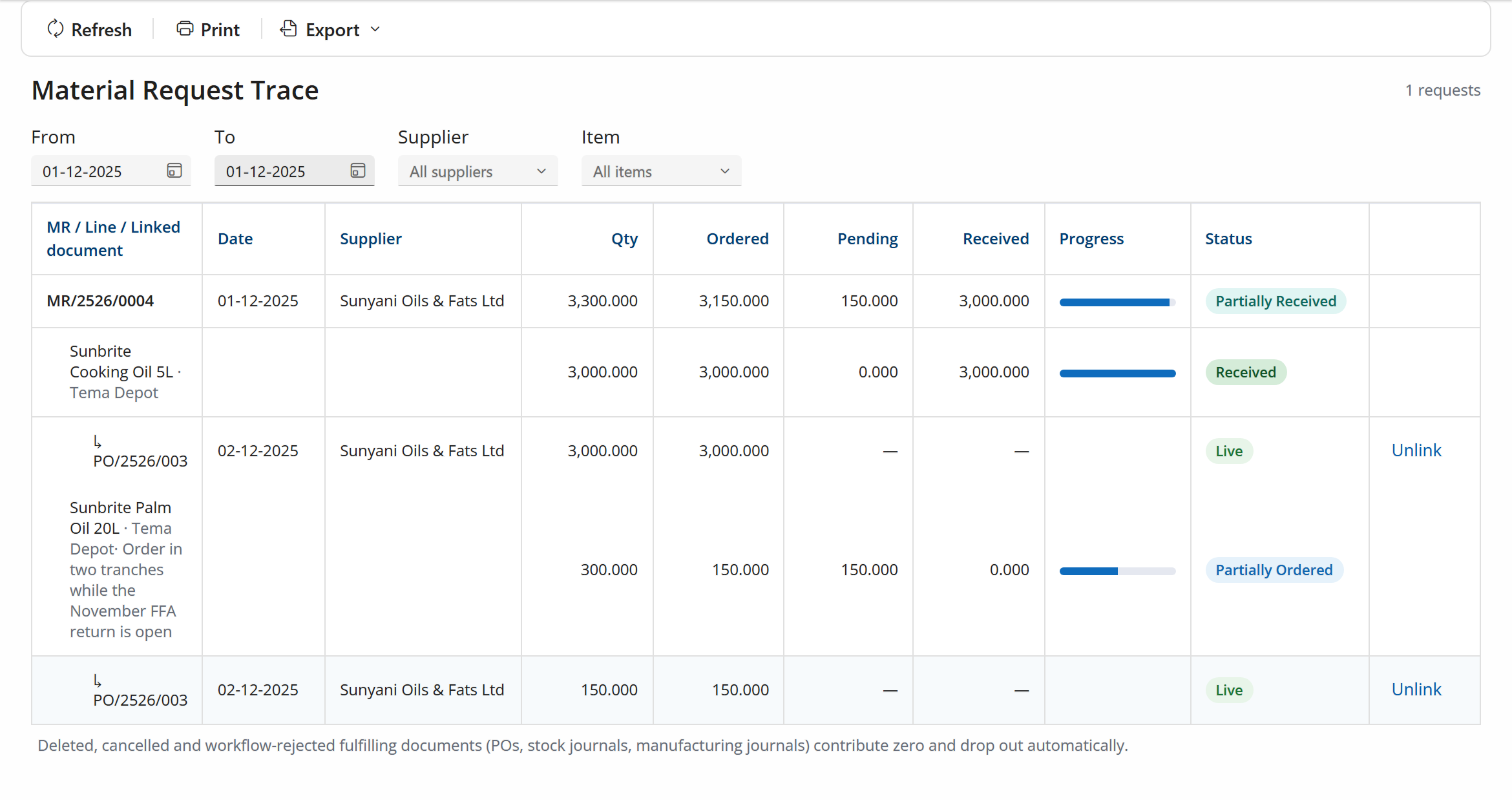
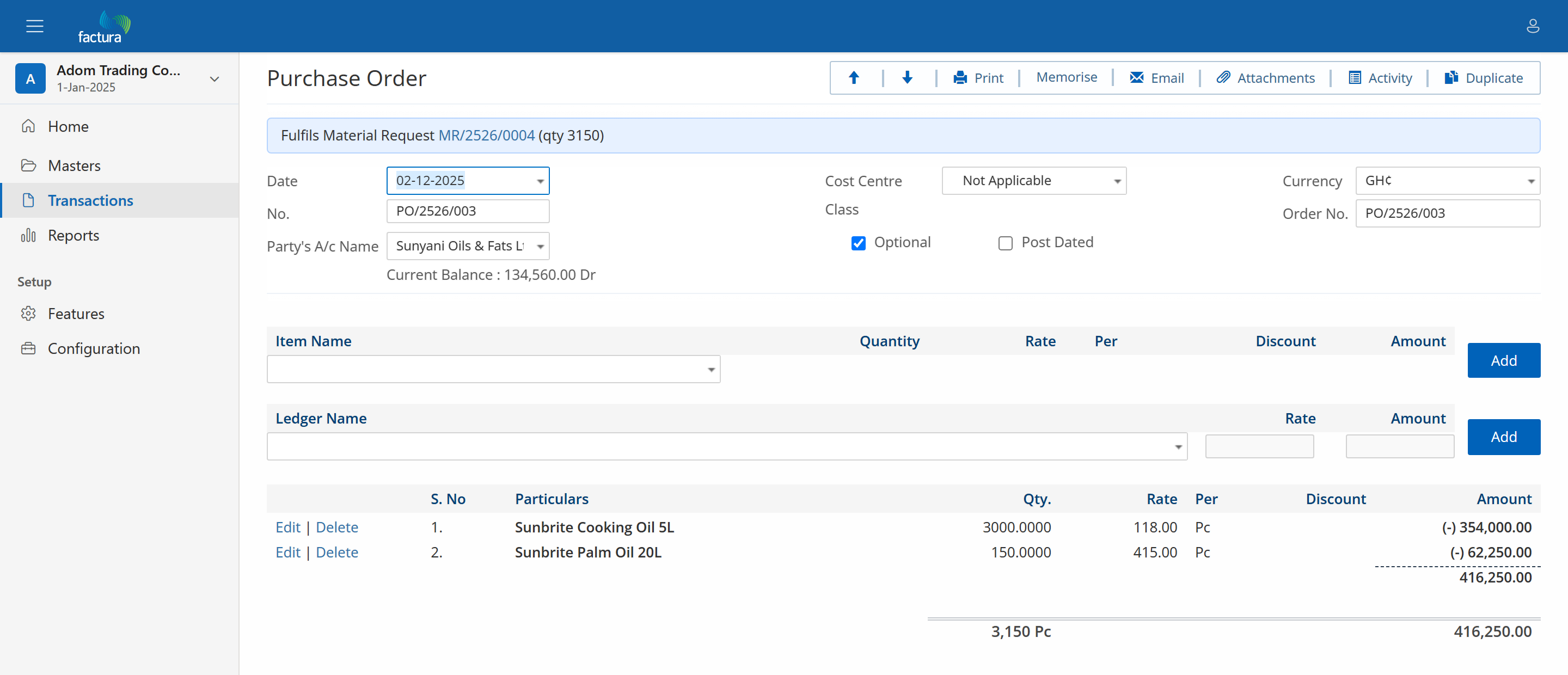
Reports. A pending-requests report with the age of each line, and a register. Requesting, approving, creating purchase orders and running the reports are separate rights.
Receipt notes and supplier invoices
Goods arriving and the bill arriving are two events, and Factura keeps them apart. The receipt note brings stock into the godown it landed in; the supplier invoice opens the bill you owe.
What it does
- Receipt notes against the order, so a part delivery does not have to be invented as a full one.
- Additional cost of purchase: freight, duty and handling folded into the landed value of the stock rather than expensed away from it.
- Purchase returns and debit notes, tracked back to the bill they relieve.
- Purchase register is the same report form as the sales register, filtered by voucher type — one shape to learn, both sides of the trade.
- No separate supplier master: a supplier is a ledger filed under Sundry Creditors, carrying its own credit period and bill-by-bill switch.
Goods that need checking before they are accepted go through quality control at the inward stage, raised straight off the receipt.
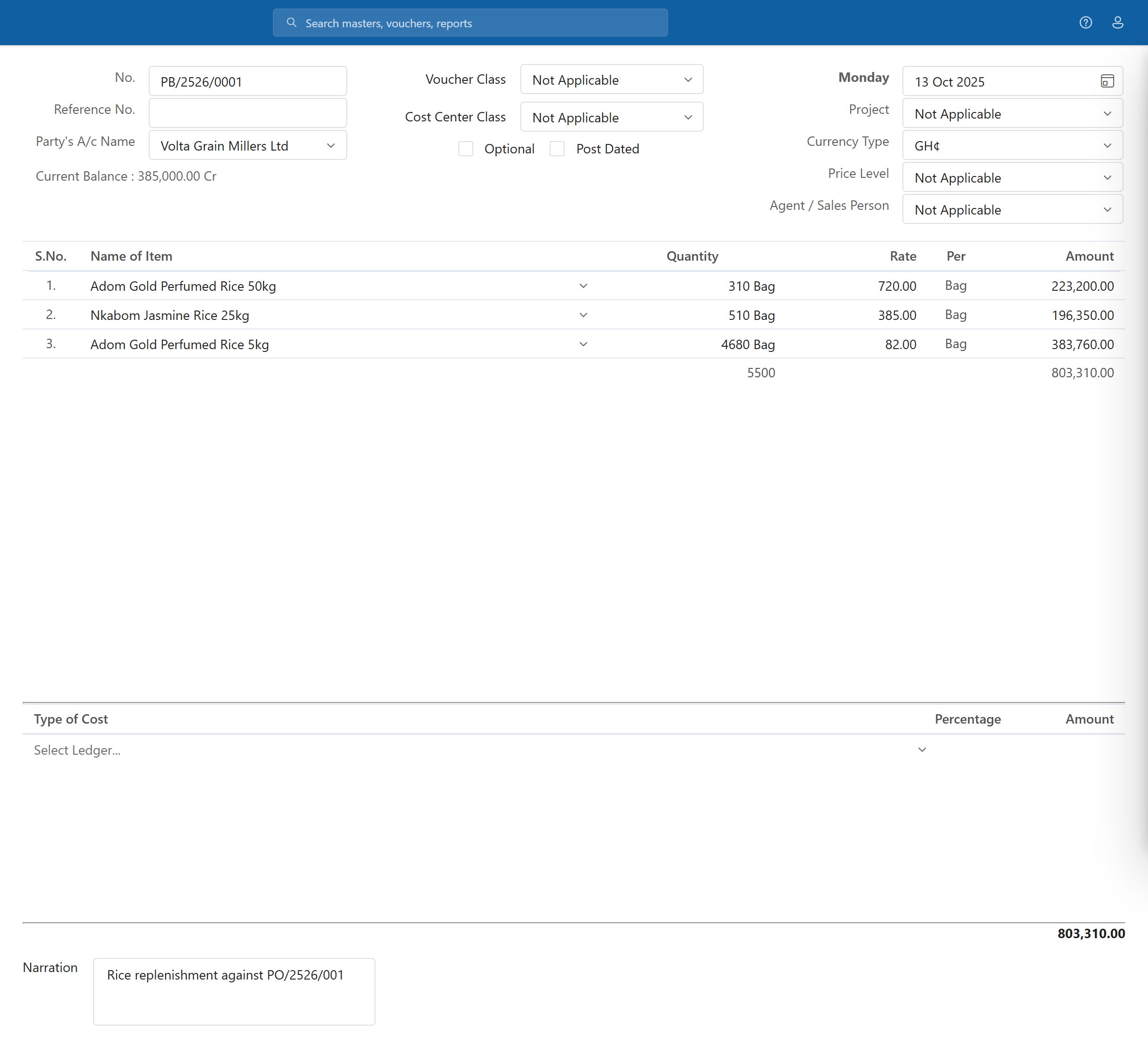
Payments, allocated to the bill they settle
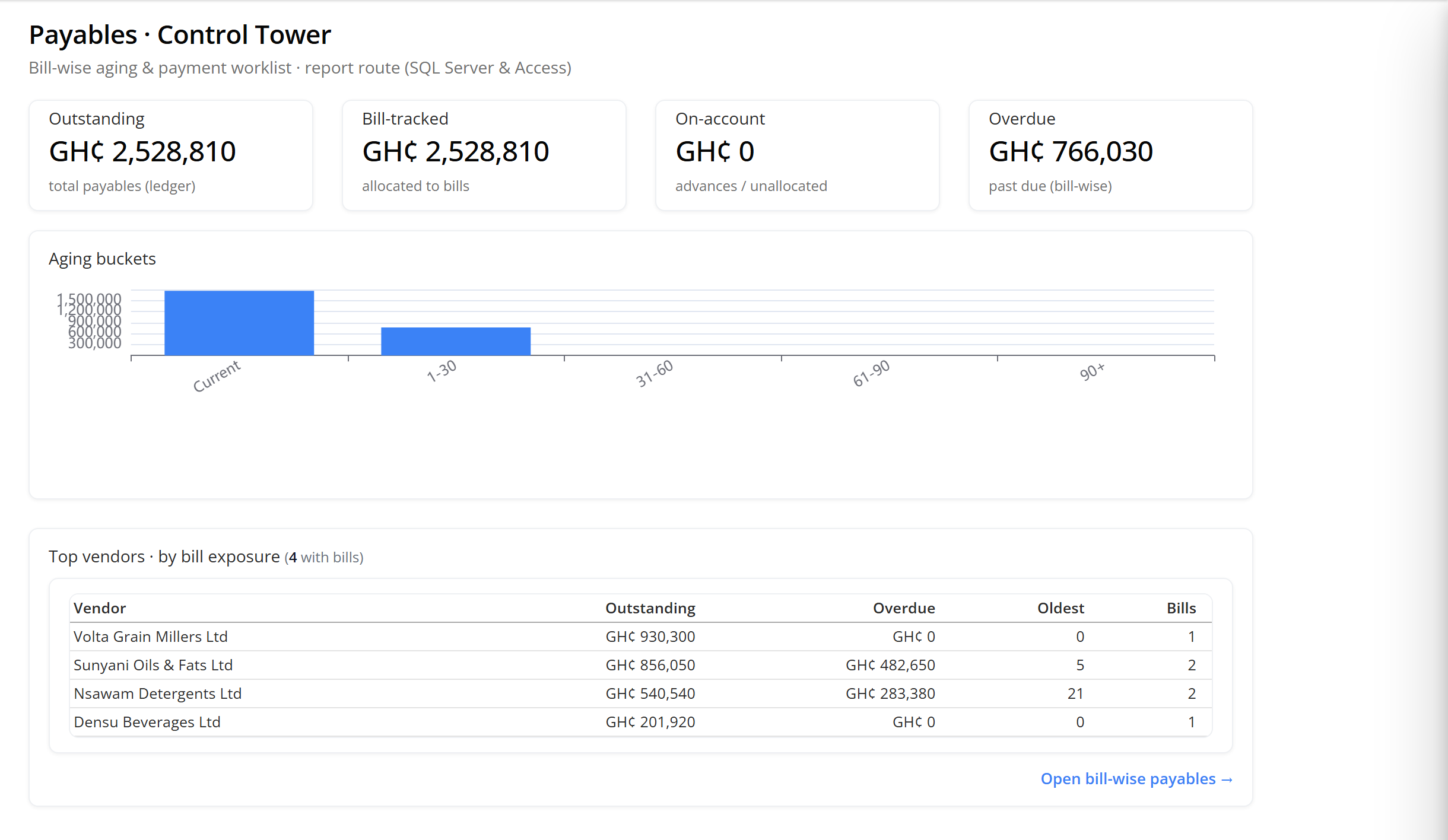
A payment is applied bill by bill, the same way a receipt is on the sales side. That is what makes the ageing on the screen at the top of this page mean something: bill-tracked exposure plus on-account balances equal what the ledger says is outstanding.
What it does
- Bill-wise payment allocation: against a named supplier bill, on account, or as an advance.
- Withholding tax captured on the payment voucher: a withholding ledger and an amount recorded against the payment as you make it.
- Foreign-currency suppliers: the exchange difference is computed into the balance sheet and the profit & loss.
- Advances and on-account payments held as their own allocation type, so an unapplied payment is visible rather than netted away.
Where the boundary is. Withholding tax in Factura is capture: the ledger and the amount are recorded on the payment so your books and your supplier statement agree. Factura does not produce a withholding tax certificate and does not file a withholding return. If that matters to your process, say so at the demo and we will tell you what today’s customers do instead.
Payables and supplier ageing
The control tower is the funding conversation in one screen, what is outstanding, how much of it is past due, and which supplier it sits with. It is the screen at the top of this page.
What it does
- One identity you can check: bill-tracked exposure plus on-account balances equal what the ledger says is outstanding.
- Ageing buckets off the allocations, not off an invoice date guess.
- Top vendors by exposure, with how many bills each carries and how old the oldest is.
- Straight through to the report: the tower opens the canonical bill-wise payables report by its own report id, so the screen and the report cannot disagree.
- Overdue payables as its own case of the same shared report the sales side uses for receivables.
Who can do what
Purchasing is where an authorisation question usually gets asked first, so it is worth saying plainly how control is enforced.
- Rights are per screen.
- Every window, each voucher-entry screen and each report, is a node in a tree, with create, alter, delete, print and display set independently against a security profile, and profiles assigned to users.
- Approvals are a sequence, not a flag.
- The workflow engine walks a configured chain of approvers, tracks what is pending against each of them, records what has completed, and emails the next approver in line.
- The period cut-off is a books-level lock.
- Once a period is closed, it is closed for everyone, rather than voucher by voucher.
- Records carry who touched them.
- Created-by, modified-by and the timestamps sit on the record. That is stamping, not a field-by-field change history — Factura does not keep a before-and-after of every edit.
Before you ask us
Does it handle withholding tax?
It captures it. The payment voucher carries a withholding ledger and a withholding amount, so the deduction is in your books against the right supplier bill. It does not generate a withholding tax certificate and it does not file a return; that stays with you or your accountant.
Can we require an approval before a purchase order goes out?
Yes. The approver chain is configured as a sequence, each approver sees what is pending against them, the next one in line is emailed, and the completed history stays on the document.
Where does freight and duty go?
Into the value of the stock. Additional cost of purchase is captured on the receipt note or the invoice and folded into the landed value, so your closing stock and your margin both reflect what the goods actually cost to get here.
Do we have to keep a supplier list separate from the ledger?
No. A supplier is a ledger under Sundry Creditors. Its credit period, its bill-by-bill tracking and its currency live on that one record, and the payables ageing is read off the bills allocated against it.
The rest of the modules
Everything a purchase touches is on one of these pages.
- General ledger.
- Where the supplier bill and the payment land. See the General Ledger →
- Inventory.
- What the receipt note brings in, valued by the method you set. See Inventory →
- Sales and invoicing.
- The other side of the same chain, through to the receipt. See Sales & Invoicing →
- Manufacturing.
- What the components you bought become. See Manufacturing →
- Analytics.
- The payables tower in full, beside Action, Position and Performance. See Analytics →
- What you capitalise.
- A purchase that is an asset rather than a cost goes into the register, where it picks up a life, a residual value and a depreciation method. See Fixed Assets →
- All of it together.
- Back to Factura Financials →
See a month close, end to end
Thirty minutes. Post, reconcile, report — and you can stop us anywhere.