
Heavy assets, currencies that do not match, and one Ghana-specific purchase quirk.
Fuel and oil businesses carry fixed assets that depreciate, buy and sell across currencies, and run into a purchase-invoice behaviour Ghana’s tax rules created for exactly this trade. This is what Factura Financials does with each of those, as built.
What an oil & gas business needs from its books
- Fixed assets, tracked and depreciated.
- Tanks, pumps and vehicles sit in a register with a cost, an in-service date, a residual value and a useful life, depreciating on a method set per category and posting into the ledgers that category names. See Fixed Assets →
- More than one currency.
- Currencies are a master, a ledger can be kept in one, and the resulting exchange difference is computed into the balance sheet and profit & loss. See General Ledger →
- Cost by site or depot.
- Cost centres nest under a parent with no depth limit found in the code, so a site, a station or a depot can each be its own cost centre. See General Ledger →
- The Ghana Oil Invoice setting.
- A licence-gated behaviour that fires only on purchase vouchers: it folds a linked journal’s tax or allocation amount into the purchase invoice as an additional cost of purchase, and removes the companion journal if the invoice is deleted. See Purchasing →
- Ghana’s VAT, NHIL and GETFund on every sale.
- A dedicated GRA E-VAT plugin issues signed invoices to the tax authority’s VSDC API, and the mobile app prints the resulting SDC ID and QR code on an 80mm thermal receipt at the point of sale. See the VAT calculator →
The register, in practice
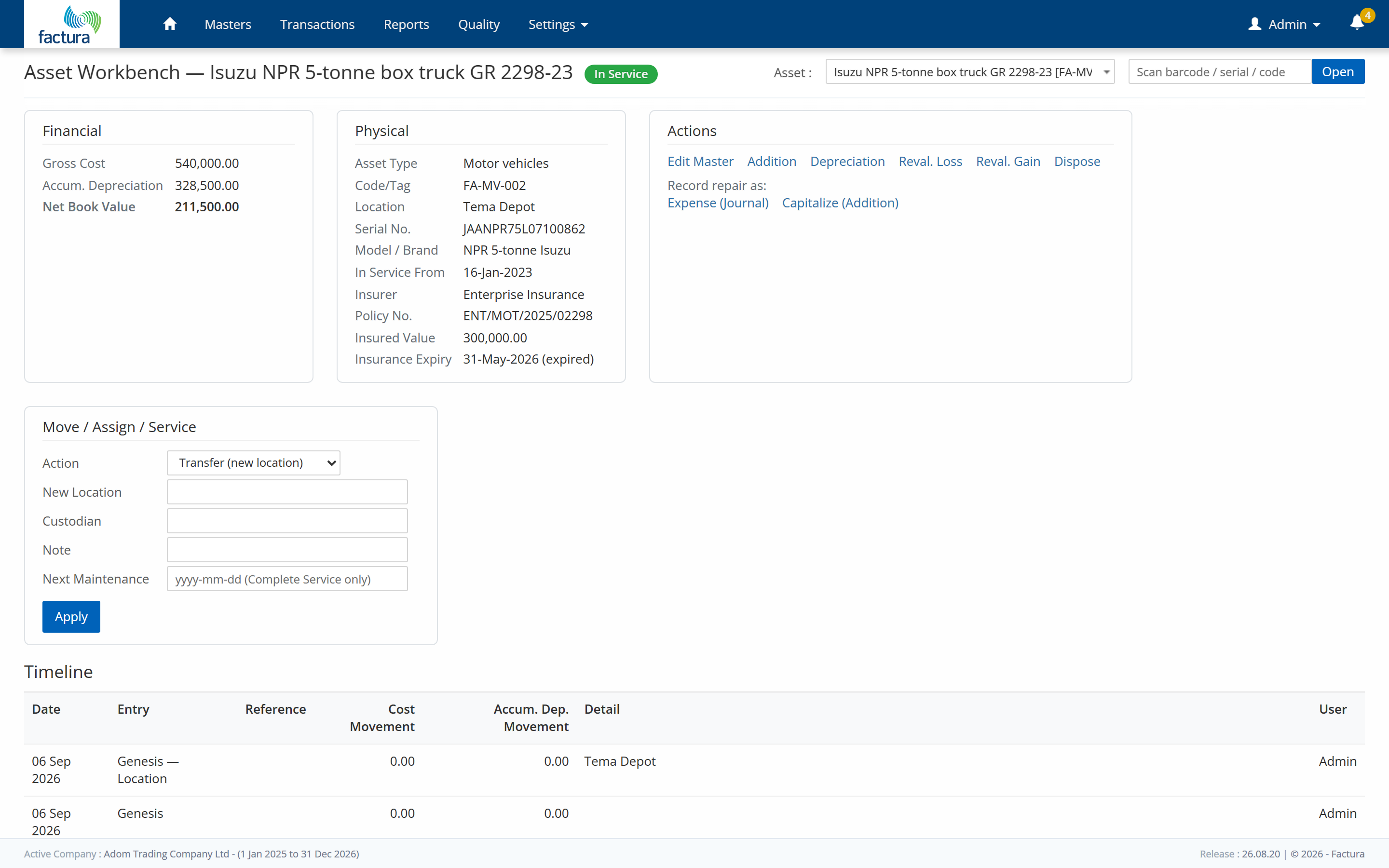
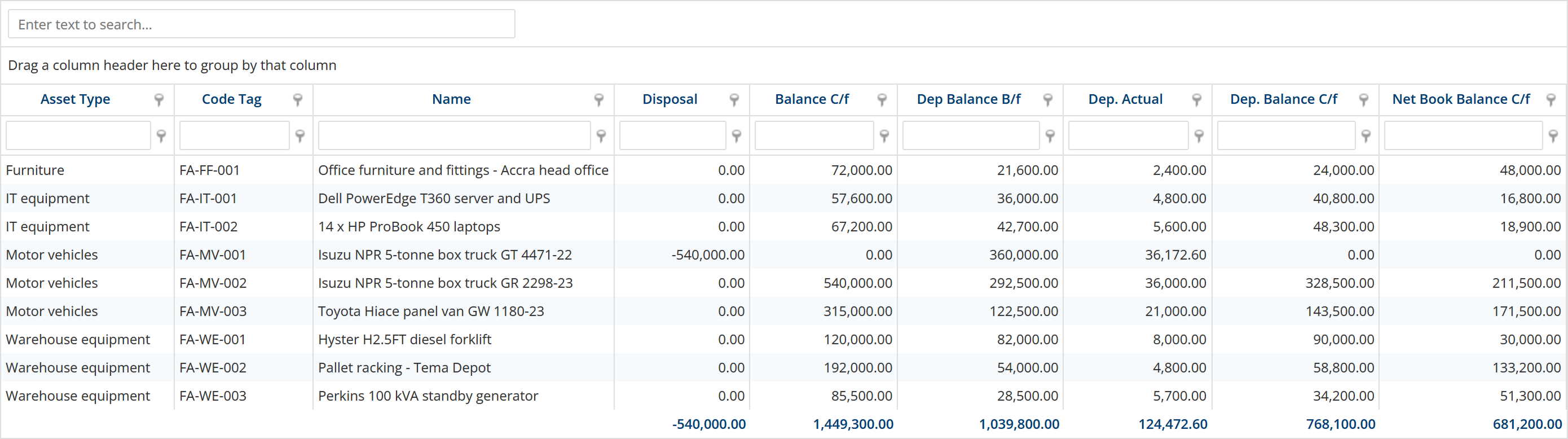
Every asset carries its own cost, in-service date and depreciation, on one screen, and the register totals to the same net book value the trial balance closes at. The captures below are from Factura’s demo company, which holds vehicles and warehouse equipment — the mechanics are identical for tanks, pumps or any other asset category you set up.
What the Ghana Oil Invoice setting actually does
It is licence-gated and fires only on purchase vouchers. When it is on, a linked journal voucher’s tax or allocation amount is folded into the purchase invoice as an additional cost of purchase — the fuel or oil you bought is costed with that amount already inside it, rather than left as a separate line you have to remember to add. Delete the invoice, and the companion journal it created is removed with it.
Factura Financials also states multi-company, multi-currency accounting with country-specific tax handling directly on its product page — see the full statement on the Financials product page →.
A foreign-currency purchase, settled
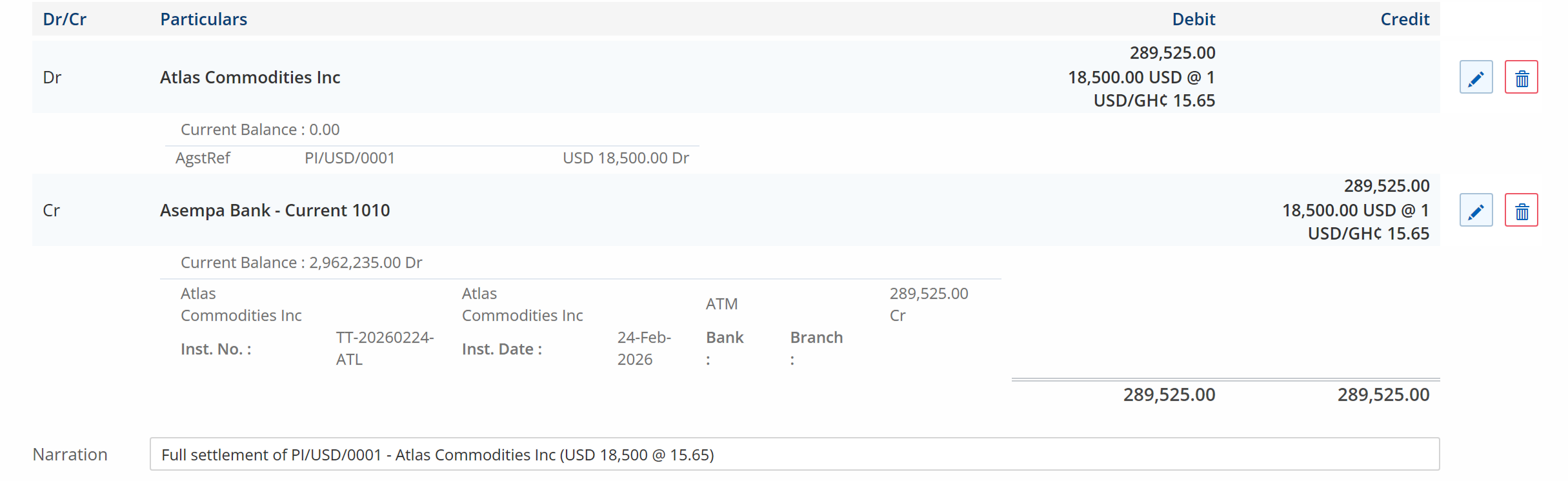
Crude, refined products and equipment are commonly bought in US dollars against a cedi bank account. The voucher below is what that settlement looks like: one payment, both currencies, the rate that ties them together.
Reports they run
Trial Balance, Profit & Loss, Balance Sheet, Depreciation, Cost Centre reports, and the boxed VAT-return report covering output VAT, input VAT reclaimed and total supplies — all part of the standard catalogue.
What we do not do
The Ghana Oil Invoice setting is not a fuel-specific print format and not a litres or volume field set — it is a narrow purchase-costing behaviour, and we describe it that way rather than sell it as a general oil-and-gas module. There is no dedicated tank-gauge, pump-metering or fuel-density feature anywhere in the product.
Before you ask us
What does “Ghana Oil Invoice” actually do?
It folds a linked journal’s tax or allocation amount into a purchase invoice as an additional cost of purchase, on purchase vouchers only, and is licence-gated. It is not a fuel-specific print format or a volume field set.
Does it calculate depreciation on our tanks, pumps and vehicles?
Yes. Each asset carries its cost, in-service date, residual value and useful life, and depreciates on straight line, diminishing value or not at all, prorated by day count. The run posts over a date range you choose and charges only the difference against what is already posted. The Fixed Assets page has the detail →
Can we invoice in US dollars and record in cedis?
Yes. Currencies are a master, and the resulting exchange difference is computed into the balance sheet and profit & loss.
Built for a different sector: Trading & distribution, Manufacturing, NGOs, Credit societies, or back to Factura Financials.
See a month close, end to end
Thirty minutes. Post, reconcile, report — and you can stop us anywhere.