
What a batch actually cost to build, not just what the ingredients cost to buy.
A manufacturer’s books have to hold a recipe, a production run and a cost, and connect all three back to the same stock item. This is what Factura Financials does with each of those, as built — and what it does not pretend to do.
What a manufacturer needs from its books
Manufacturing is a separately licensed module in Factura Financials — without the licence flag, its menus, its process-journal voucher option and its three reports are hidden.
- A recipe for each finished item.
- A stock item can carry more than one named bill of materials, each with a base quantity, and one marked as the default. See Manufacturing →
- Turn a recipe into a production run.
- The Manufacturing Journal explodes the chosen BOM and computes the maximum quantity you can actually produce from stock on hand. See Manufacturing →
- See what a run actually used.
- The Material Consumption Summary report and the Manufacturing Journal Comparison/Variance reports compare planned against actual consumption. See Manufacturing →
- Cost a job.
- There is no separate job-costing module — a job is costed through the same cost-centre and project-accounting machinery the rest of the ledger uses, with a dedicated job work analysis report reading off it. See General Ledger →
- Depreciate the plant that made it.
- Machines are fixed assets in their own register, each with a cost, a useful life and a residual value, charging depreciation to the expense ledger their category names — on the same profit and loss as the materials they consumed. See Fixed Assets →
The same ledger costs the job
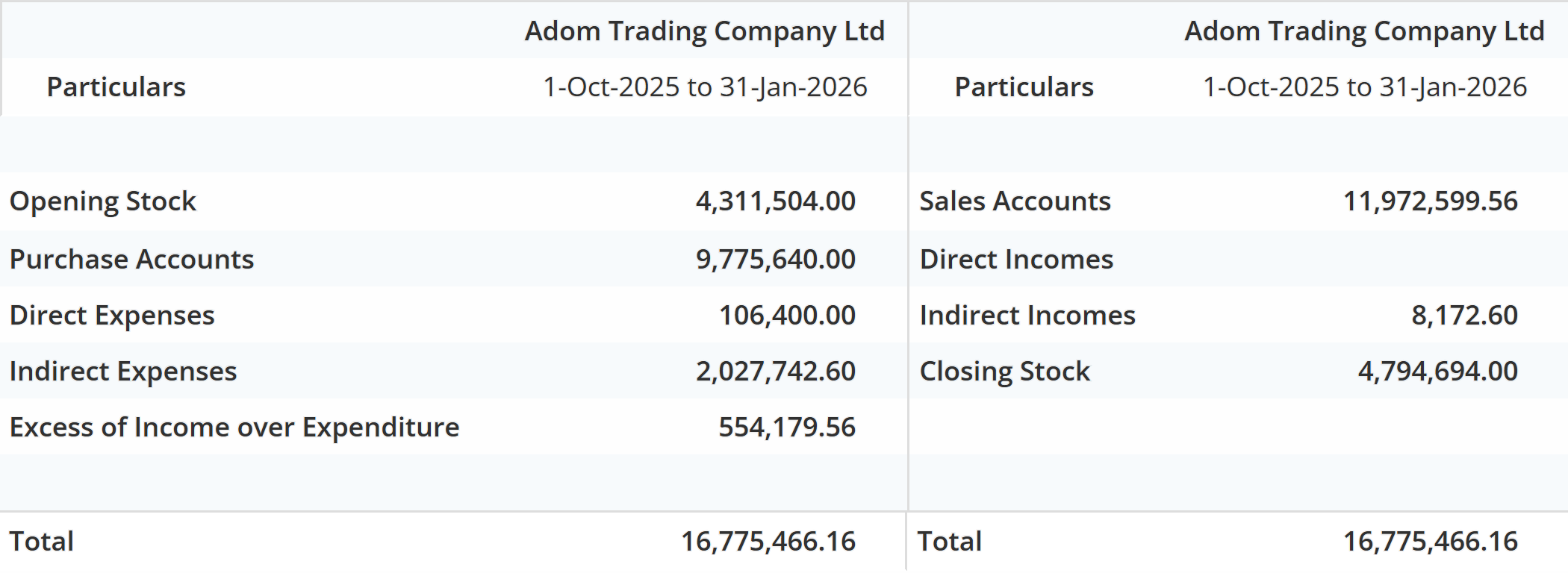
Direct and indirect expenses on a production run land in the same profit and loss a trading company uses — nothing about manufacturing gets a separate set of books.
Reports they run
Manufacturing Journal Comparison, Manufacturing Journal Variance, Manufacturing Reorder Status, Manufacturing Order Details, and Material Consumption Summary — the reports that come with the module when the licence is on.
What we do not do
There is no dedicated job-work-in or job-work-out voucher type or master — job costing rides the generic cost-centre and project-accounting flags, not a distinct manufacturing module. No co-product or by-product fields were found on the bill of materials. And of the eight stock-valuation methods the item form declares, only six are actually wired into the calculation engine — LIFO-Perpetual and Monthly-Average-Cost are not: stick to FIFO, LIFO, weighted average or standard costing when you set up an item that manufacturing will consume.
Before you ask us
Is Manufacturing included by default?
No. It is gated by a separate licence flag; without it, the module’s menus, its process-journal voucher option and its three reports are hidden on every company you open.
Does it track job costs directly?
Not as a separate job-costing module. A job is costed through the same cost-centre and project-accounting machinery the rest of the ledger uses.
Can one item have more than one recipe?
Yes. A stock item can carry several named bills of materials, each with its own base quantity, with one marked as the default.
Built for a different sector: Trading & distribution, NGOs, Credit societies, Oil & gas, or back to Factura Financials.
See a month close, end to end
Thirty minutes. Post, reconcile, report — and you can stop us anywhere.